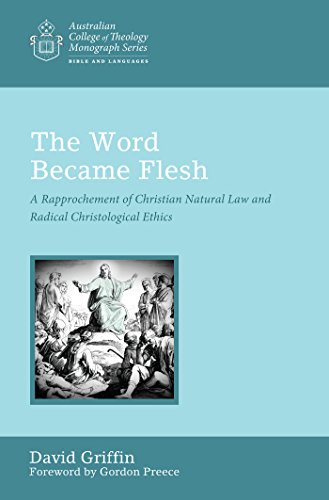
Is following Jesus usual? Many may say no, yet this ebook argues certain. asserting no means that grace and human nature are exchange ethical different types. announcing certain signifies that our humanity is gracious in beginning, potential, and cause. a lot of this dialogue hangs on what's intended by means of "nature" and "natural," and this booklet explores those rules creationly and christologically. half One considers usual legislations as generally present in the classical Christian culture. half explores the unconventional christological culture of Anabaptism. half 3 then proposes the two-nature christology of the Chalcedonian definition as a theological source allowing their reconciliation. The Chalcedonianism of the fashionable Barth and the traditional Maximus the Confessor are appropriated, in addition to clinical theology of T. F. Torrance and Nancey Murphy. If Chalcedon adequately affirms Jesus's humanity as being homoousios (one nature) with our humanity, created like Adam's throughout the everlasting Spirit, then Jesus's lifestyles used to be natural--proper to its created cause. And as his divine nature was once homoousios with the Father's nature, he's the human expression of the divine notice which provides construction its contingent ethical rationality. As such, the lifetime of Jesus (Anabaptists' trouble) is morally normative for all humanity (natural law's concern).
"Griffin's bold booklet rejoins the oft-separated classical theological culture of the emblems and the novel Christocentric Anabaptist culture. His theological peace-making and powerful argument supply a wealthy synthesis of obvious opposites. Shed your skepticism to work out what coherence Griffin uncovers via this rapprochement and what radical theological and moral fruitfulness very likely follows."
--Gordon Preece, Director of Ethos: Evangelical Alliance Centre for Christianity and Society, Melbourne, Australia
"Orthodox and radical? average and in sync with (the radical ethics of) the note made flesh? certain, says David Griffin during this well-written and difficult booklet. simply for the time being whilst there appears an uptake in curiosity in common legislations and questions raised approximately even if orthodoxy can healthy with radical, Christ-centered ethics, this publication sheds much-needed gentle at the topic. What a well timed intervention, commencing up clean angles on age-old subjects."
--Mark Thiessen country, Coauthor, Bonhoeffer the Assassin? (2013)
"Finally, somebody has dared to do the possible unthinkable! Griffin's bold argument aren't the final word concerning the dating among Christocentric radicalism and normal legislation, however it serves excellently as a fruitful (and simply just a little polemical) provocation."
--Paul Martens, affiliate Professor of faith, Baylor University
"This complex book explores a fancy subject: the relation of typical legislation and radical christological ethics to Christology right. this can be a major query approximately which Griffin makes vital claims. through reconciling them when it comes to Chalcedonian Christology, he allows normal legislations ethics to be extra robustly Christian, and radical christological ethics to be extra open to the area. Griffin's wide-ranging dialogue rewards cautious interpreting with difficult and stimulating insights, making the hassle good worthwhile."
--Andrew Sloane, Morling College
David Griffin is the Minister of North Canberra Baptist Church, Australian Capital Territory, Australia. he's a member of the Anabaptist organization of latest Zealand and Australia, and a chaplain on the Australian nationwide collage, Canberra. He has pastored Baptist church buildings for greater than 3 many years. His study pursuits comprise theological ethics and twentieth-century theology. His different pursuits contain recreation and cabinetmaking.