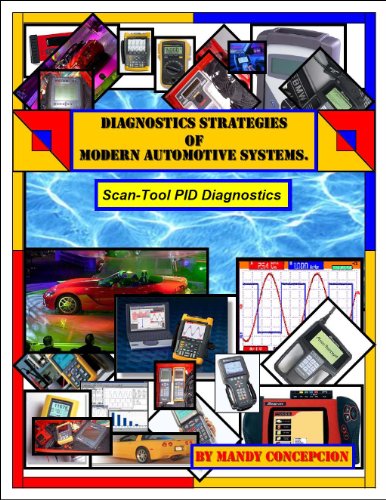
during this publication, the various ideas of experiment device parameter (PID) research should be uncovered. recommendations concerning PID research are quick catching on, as a result of their velocity and accuracy. via effectively interpreting the several scanner PIDs, the technician can arrive on the resource of the matter a lot swifter and correctly. those approaches provide upward thrust to the hot time period “driver seat diagnostics”, seeing that many of the initial diagnostic paintings is completed during the scanner. in spite of the fact that, those strategies will not at all exchange the ultimate handbook checks which are part of each diagnostic course. they're easily geared to indicate the technician within the correct direction.
Edition 4.0 part 6 – experiment instrument PID Diagnostics, Copyright 2004, 2011, All rights reserved.
Table of Contents
- INTRODUCTION
(Introduction to test software diagnostics and the relevance of utilizing PIDs or scanner parameter to accomplish the 1st leg of all diagnostics.)
- thought of Operation in the back of the several PIDs
(Describes CARB, the adaptation among everyday and better PIDs, the FTP)
- OBD II time-honored PIDs
(PID calculated and real values, calculated info relationships, base injection timing, ECM worth substitution)
- OBD I & II normal PID analysis
(erasing code-or now not, recording, examining and pinpoint assessments, setting apart PIDs into groups)
- gas supply Fault Detection
(fuel supply matters, consumption air temp. sensor, BARO sensor, Engine LOAD, RPM PID, momentary gas Trims, long term gas Trims, 60% of cost engine gentle matters, block learn/integrators, Example1: injector fault, instance 2: consumption gasket matters, gas prestige, ignition timing, MAP/MAF, TPS, O2 sensor, IAC, Closed Throttle, injector pulse width, voltage strength, injector duty-cycle, gasoline trim cell)
- try no 1 (Determining an engine’s gas Consumption
(rich-lean operation, duty-cycle to gas trim courting, O2 sensor to gasoline trim relation, toes and vacuum leaks, ignition timing and idle regulate, attempt conclusion)
- try # 2 (Misfire Detection technique, EGR, Ignition and Mechanical misfires)
(misfires and OBD2, scanner misfire detection – a time saver, OBD2 forty and eighty cycle misfire, ignition, injector and EGR density misfire, coil-on-plug, misfires and O2 sensor, lean O2 & Secondary misfire, O2 sensor & injector misfires, leaky injector, EGR and the MAP, kind A, B, C misfires, try conclusion)
- attempt # three (Air/Fuel Ratio Faults)
(air-fuel imbalance, MAF and put up O2 sensors, open-closed-loop, gasoline let, HC & CO relation to AF matters, try out conclusion)
- try # four (BARO, MAP & MAF PID analysis)
(MAP & valve timing faults, ECM habit, gas supply or accountability cycle attempt, volumetric potency, , attempt conclusion)
- try out # five (Clogged exhaust)
(clogged catalytic converter detection, TPS, MAF and converters, idle and WOT or broad open throttle values, vacuum readings, MAP to WOT chats research, engine and MAP vacuum, try conclusion)
- try # 6 (EGR Fault Detection)
(EGR and MAP values, ECM response to EGR concerns, EGR temp sensor, DPFE sensor, EGR and O2-MAP and raise place sensor, EGR and engine pre-loading, EGR and the ECM misguided excessive LOAD matters, attempt conclusion)
- try out # 7 (O2 Sensor Heater)
(O2 warmers and why?, difficult to examine O2 heater concerns, O2 heater impression on sign output, O2 heater bias voltage, engine off and O2 altering worth, attempt conclusion)
- try # eight (Resetting gas Trims)
(resetting injection pulse corrections, long term and non permanent gas trims, research , Lambda, case research on gas trims, toes resetting in keeping with producer, try out conclusion)
- attempt # nine (Engine Cranking Vacuum Test)
(MAP/MAF cranking vacuum, vacuum to PID research, vacuum leaks, gauge-PID attempt, assets of leaks, cranking values, attempt conclusion)
- NOTES