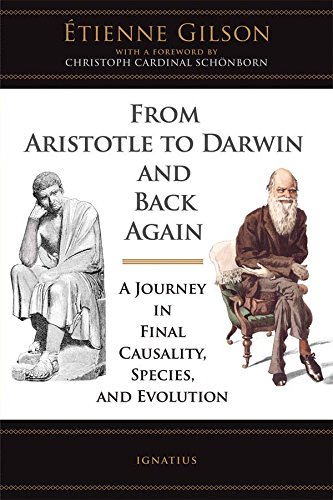
By Etienne Gilson
Foreword by way of Christoph Cardinal Schönborn
Darwin’s idea of evolution is still arguable, even if such a lot scientists, philosophers, or even theologians settle for it, in a few shape, as an evidence for the diversity of organisms. the debate erupts while the speculation is used to aim to provide an explanation for every thing, together with each point of human lifestyles, and to disclaim the position of a author or a function to existence.
The overreaching of many scientists into concerns past the self-imposed limits of clinical strategy could be defined partially via the lack of very important rules in smooth thinking—final causality or objective, and formal causality. Scientists understandably bracket the belief out in their medical pondering simply because they search factors at the point of fabric and effective motives simply. but a lot of them wrongly finish from their selective research of the area that ultimate and formal explanations don't exist in any respect and they haven't any position within the rational examine of existence. Likewise, many erroneously think that philosophy can't draw upon clinical findings, in mild of ultimate and formal causality, to raised comprehend the realm and guy.
the nice thinker and historian of philosophy, Étienne Gilson, units out to teach that ultimate causality or purposiveness and formal causality are ideas in the event you imagine demanding and thoroughly in regards to the international, together with the area of biology. Gilson insists thoroughly rational figuring out of organisms and organic platforms calls for the philosophical idea of teleology, the concept convinced different types of issues exist and feature ends or reasons the success of that are associated with their natures—in different phrases, formal and ultimate explanations. His technique will depend on philosophical reflection at the evidence of technology, now not upon theology or an entice spiritual specialists akin to the Church or the Bible.
“The item of the current essay isn't really to make of ultimate causality a systematic idea, which it isn't, yet to teach that it's a philosophical inevitability and, accordingly, a relentless of biophilosophy, or philosophy of existence. it isn't, then, a question of theology. If there's teleology in nature, the theologian has the correct to depend upon this truth to be able to draw from it the implications which, in his eyes, continue from it about the life of God. however the life of teleology within the universe is the item of a safely philosophical mirrored image, which has no different objective than to verify or invalidate the truth of it. the current paintings can be eager about not anything else: cause analyzing brilliant experience—does it or does it no longer finish to the life of teleology in nature?”
—Étienne Gilson
“Gilson exhibits us that those that glibly feel that glossy biology has refuted Aristotle’s doctrine of ultimate causality don't correctly comprehend both. The reprinting of this vintage will, we will desire, give a contribution to the long-overdue revival of the philosophy of nature as an energetic box of study.”
—Edward Feser, writer of The final Superstition: A Refutation of the hot Atheism
Étienne Gilson (1884–1978) used to be a well known French thinker and historian of philosophy, and a member of the celebrated French Academy. He was once a favorite chief within the twentieth–century resurgence of the philosophy of St. Thomas Aquinas. between his books are The solidarity of Philosophical adventure, The Spirit of Medieval Philosophy, and The historical past of Christian Philosophy within the center Ages.
Read or Download From Aristotle to Darwin and Back Again: A Journey in Final Causality, Species and Evolution PDF
Similar epistemology books
Karl Popper's Philosophy of Science: Rationality without by Stefano Gattei PDF
This publication seeks to rectify misrepresentations of Popperian suggestion with a historic method of Popper’s philosophy, an procedure which applies his personal mature view, that we achieve wisdom via conjectures and refutations, to his personal improvement, by means of portraying him in his highbrow progress as simply any such sequence.
The Price of Public Intellectuals (Palgrave Pivot) - download pdf or read online
This ebook presents a historically-informed survey seriously outlining sociological, mental, political, and monetary ways to the position of public intellectuals. Sassower indicates how the kingdom may possibly financially aid the basic paintings of public intellectuals as a way to significantly have interaction the general public and increase public rules.
New PDF release: Modelos o metáforas: Crítica del paradigma de la complejidad
El antropólogo Carlos Reynoso demuestra en esta obra que el pretendido “paradigma de l. a. complejidad” de Edgar Morin refleja una concepción anticuada y circunscripta de los angeles complejidad, y que se encuentra afectado por un número significativo de errores de concepto, fallas técnicas, expresiones sistemáticamente engañosas, contradicciones y lecturas sesgadas.
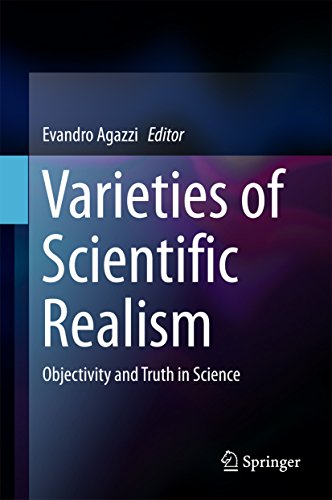
Read e-book online Varieties of Scientific Realism: Objectivity and Truth in PDF
This ebook bargains a finished replace at the clinical realism debate, permitting readers to realize a singular appreciation of the position of objectivity and fact in technology and to appreciate absolutely a number of the ways that antirealist conceptions were subjected to problem over contemporary a long time. Authoritative representatives of other philosophical traditions clarify their views at the which means and validity of medical realism and describe the innovations being followed to counter persisting antirealist positions.
- Hermeneutics and the Human Sciences: Essays on Language, Action and Interpretation (Cambridge Philosophy Classics)
- The Phenomenal and the Representational
- Why Things Matter: The Place of Values in Science, Psychoanalysis and Religion
- From Knowledge to Wisdom: Essays on the Crisis in Contemporary Learning
Additional info for From Aristotle to Darwin and Back Again: A Journey in Final Causality, Species and Evolution
Example text
From Aristotle to Darwin and Back Again: A Journey in Final Causality, Species and Evolution by Etienne Gilson
by Thomas
4.2
